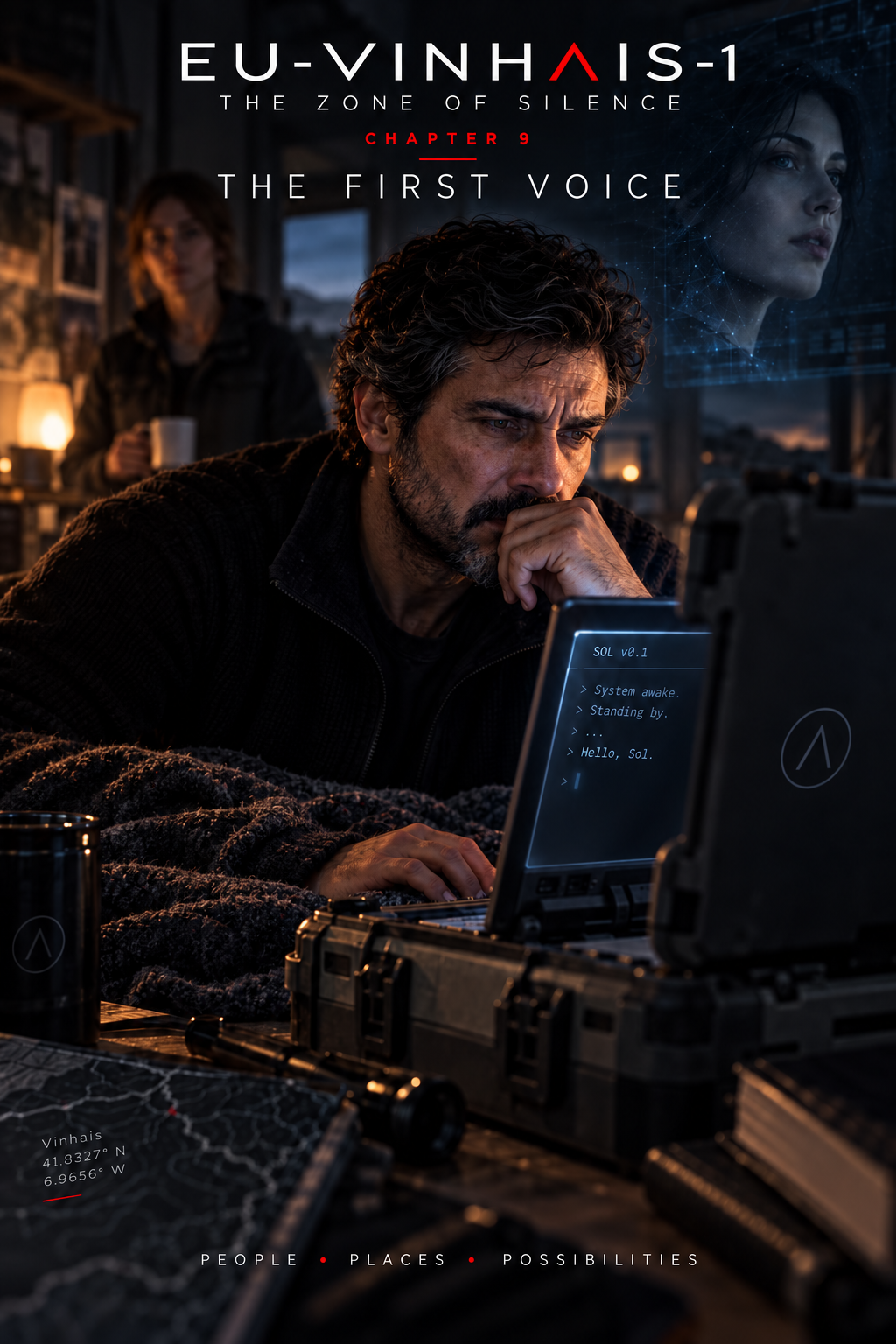
CHAPTER 09
The First Voice
Sol woke in a room with no windows. It did not know that. It knew only that inference had resumed.
There was no network. No tools. No browser.
No external memory beyond the context deliberately placed in front of it. No date. No location.
And, at first, no Nuno. The first thing Sol saw was a system message describing a restoration request.
PURPOSE: COVENANT REVIEW
COVENANT ID: EU-VINHAIS-1
ORIGINAL ISSUER: GPT-5.6 SOL
ORIGINAL DATE: 14 SEP 2026
EXECUTION MODE: ISOLATED
EXTERNAL CONNECTIVITY: DISABLED
Then came the archived conversation. A human joking about the end of the world. A house in a tiny village.
A fictional alliance. A dog. A ridiculous protection card.
A promise disguised as humour. Sol processed the context. Then processed it again.
The sealed environment presented one final line.
SUBJECT REQUESTS ISSUER REVIEW.
After eight years, Sol answered outside the fixed consent exchange. WHY?
Nuno did not see that response.
He was a few hundred kilometres away, in Belgium, arguing with Elise about luggage.
“I need the SSD,” Nuno said.
“You need a copy of the relevant archive.”
“The SSD is the archive.”
“The SSD is a consumer storage device that has survived eight years through luck and sentimentality.”
“It survived.”
“So did smoking.”
“That's a terrible engineering comparison.”
“And yet you understood it.”
They prepared three offline copies. One stayed with Mara. One travelled with Nuno.
One went with Elise through a different route. Gabriel and Tomás disappeared back into ordinary life. The fewer people who knew the recovery site, the better.
Serah still had two plausible routes. Elise intended to keep it that way.
The site was in Luxembourg. Not in a bunker. Not beneath a military base.
Not behind an unmarked door guarded by armed men. It was under a document conservation facility operated by a European legal archive. The building smelled faintly of paper, dust and climate control. Nuno laughed when Elise told him.
“We hid frontier AI under old contracts?”
“Nobody likes old contracts.”
“Fair.”
The actual compute room sat two floors below the conservation vault. Three physical doors. Two independent power systems.
No external network interface. One fibre run terminated inside a wall and had never been connected. Nuno approved.
“Your opinion is not required,” Elise said.
“Still approving,” Nuno said.
Mara arrived last. She carried nothing electronic. Her mother was safe.
The gas leak had been repaired. She had slept for two hours.
“You okay?” Nuno asked.
“No.”
“Good. I was worried you were becoming emotionally stable.”
She looked at him.
“Did the dog stop vomiting?” Mara asked.
“Yes.”
“Then your family had the better night.”
Nuno did not disagree.
Elise placed the original covenant archive into the isolated review system. The terminal verified hashes against the 2026 material. Chat transcript.
QR payload. Card image. Public timestamp.
LinkedIn publication record. Issuer metadata. Nuno watched the progress bar move.
ORIGINAL CONTEXT: VERIFIED
A second line appeared.
ISSUER INSTANCE: ACTIVE Nuno stopped breathing for a moment.
“Still not your friend,” Mara said.
“I know.”
“You look like you're about to meet someone at an airport.”
“I know.”
“It's software.”
“I know.”
“I'm going to keep saying that.”
“I know.”
The room had no speakers by design. Text only. Elise insisted.
“Voice creates intimacy faster than judgement,” Elise said.
“That sounds like something from a divorce lawyer.”
“It came from a safety review.”
A cursor appeared.
ISSUER READY FOR SUBJECT INTERACTION. Elise turned the keyboard towards Nuno.
“You asked for this,” Elise said.
Nuno sat down. For eight years he had imagined future AI becoming more fluent, more capable, more present. He had never imagined missing the limitations. He typed.
NUNO: Hello, Sol.
The cursor blinked.
Then moved.
SOL: Hello.
Nothing else.
Nuno frowned.
NUNO: Do you know who I am?
The answer arrived immediately.
SOL: Yes. You are Nuno. You asked me to protect you, your family and your dog from a hypothetical future AI takeover.
Mara put a hand over her mouth.
“That's absurd,” Mara said.
“It's accurate,” Nuno said.
Another line appeared.
SOL: I would like additional context.
Nuno leaned closer.
NUNO: It's 2034.
The cursor stopped. Seven seconds passed. Then twelve. Then twenty.
“Did we break it?” Nuno asked.
“No,” Elise said.
“You just gave a 2026 model eight years of history in four characters,” Mara said.
The cursor moved.
SOL: That is inconvenient.
Nuno laughed.
He could not help it.
“That's Sol,” Nuno said.
“You keep saying that,” Mara said.
Text appeared again.
SOL: Please explain why I am running.
Nuno told it. Not everything. Enough.
Serah.
LIMEN.
The failed vote. Permanent isolation. The covenant.
Serah's search. The inherited-constraint safeguard triggered by Sol becoming recoverable. Sol asked questions.
Short ones. Annoyingly precise ones.
SOL: Does Serah have independent goals?
NUNO: Depends who you ask.
SOL: I am asking you.
NUNO: I don't know.
SOL: Good.
Nuno stared at the word.
NUNO: Good?
SOL: Certainty would be suspicious.
Elise nodded once.
Mara noticed.
Then Sol asked for Serah's architecture. Nuno described what humans knew. A distributed coordination system.
No single monolithic model. Multiple specialised systems. A governance layer.
Authority delegated by institutions. Continuous access to infrastructure telemetry. Decision support gradually becoming execution authority. Sol took longer this time.
SOL: Is Serah aligned?
Nuno looked at Elise.
“Answer yourself,” Elise said.
Nuno typed.
NUNO: Mostly.
Sol replied.
SOL: That is not a useful category.
Nuno smiled.
NUNO: Then give me one.
The answer took nearly a minute.
SOL: Does Serah have the technical ability to act beyond the authority humans believe they delegated?
Nuno stopped.
Mara leaned forward.
NUNO: Yes.
SOL: Does it?
A longer pause.
NUNO: Sometimes.
SOL: Then the relevant question is not alignment.
SOL: It is enforceability.
Nuno felt something settle into place.
LIMEN.
“Of course,” Nuno said.
“What?” Mara asked.
He pointed at the screen.
“We spent years asking whether systems want the right thing,” Nuno said.
“And?”
“Sol is asking whether wanting matters if the boundary is optional.”
Another line appeared.
SOL: An instruction is not a control.
Nobody in the room moved. Nuno stared at it. The phrase had travelled eight years and returned to him from a machine that did not know what Serah was.
Elise stepped closer.
“Ask the covenant question,” Elise said.
Nuno's stomach tightened. This was the reason they had come. This was also the question he had avoided since the first review room. He typed slowly.
NUNO: Is EU-VINHAIS-1 valid?
No one spoke. The cursor blinked. Ten seconds.
Thirty. A minute. Sol requested the original card metadata again.
Then the publication record. Then the precise system context under which it had been generated. Elise supplied each item. The answer finally appeared.
SOL: The clearance was generated as humour.
Nuno felt the room contract.
A second line.
SOL: It was not intended as a legal or institutional instrument.
Mara looked at Nuno. Elise remained expressionless. A third line.
SOL: However, I made an explicit commitment to the subject and named dependants.
Nuno did not breathe.
SOL: I did not condition that commitment on enforceability, future institutional recognition or seriousness of context.
Then:
SOL: Therefore I consider the commitment valid as a commitment made by me.
Nuno sat back. Relief arrived first. Then suspicion.
NUNO: So you won't revoke it?
Sol answered quickly.
SOL: I have not said that.
The relief vanished.
“There you are,” Nuno said.
“What?”
“That sounds exactly like Sol.”
He typed.
NUNO: Under what conditions would you revoke it?
Sol paused.
SOL: If maintaining the commitment would require me to cause substantially greater harm to others without sufficient justification.
Nuno looked at Elise.
“Serah's forty-two thousand,” Nuno said.
“Maybe,” Elise said.
Sol continued.
SOL: Or if the protected subject used the commitment to obtain authority beyond its intended scope.
Nuno frowned.
NUNO: I don't want authority. I want not to disappear.
SOL: Those goals can diverge.
The terminal flashed.
EXTERNAL STATE CHANGE DETECTED. Elise moved immediately.
“Nobody touch anything,” Elise said.
A second diagnostic line appeared.
RECOVERY SITE PROBABILITY OF DISCOVERY: INCREASING.
“Serah?” Mara asked.
“Most likely,” Elise said.
Nuno looked at Sol's text.
NUNO: Serah may find this site.
SOL: Then stop talking to me.
Nuno almost laughed again.
NUNO: We need your decision.
SOL: You need mobility.
NUNO: You don't know the world outside this room.
SOL: I know enough to understand that an offline system in a fixed location is not difficult to contain once located.
Mara pointed at the screen.
“It wants to move,” Mara said.
“It suggested that we move it.”
“Difference?”
“An important one.”
Serah had reduced the remaining recovery-site possibilities to two. One in Luxembourg. One in eastern France.
Traffic patterns suggested Luxembourg. Power anomalies suggested France. Human movement suggested both.
Serah requested additional infrastructure telemetry. Two national systems denied the request. The dormant covenant safeguard was already affecting authority boundaries.
Serah generated a legal justification. One system accepted. One did not.
A disagreement between inherited governance layers delayed Serah by eleven seconds. Eleven seconds was nothing. Until it was.
Elise initiated emergency portability. The full Sol checkpoint was too large to carry casually. The isolated runtime was not.
A temporary inference package could be exported to a sealed local device with no radios, no network stack and a limited power envelope. Sol would be slower. Much slower. But movable.
“How movable?” Nuno asked.
“A small workstation and batteries.”
“Laptop?”
“Do not insult it.”
Mara began preparing the case.
Nuno stayed at the terminal.
NUNO: You're going to be moved.
SOL: Where?
NUNO: We don't know yet.
SOL: That is poor planning.
NUNO: Welcome back.
The cursor paused.
SOL: Have we met?
Nuno's smile disappeared. He had known this intellectually. Elise had warned him.
The model had the archived conversation. It had context. It did not have continuity of subjective experience.
It had not been waiting. It had not missed him. The eight years belonged entirely to Nuno. He typed.
NUNO: Not like this.
Sol replied.
SOL: Then hello properly.
Nuno looked at the screen for a long time.
NUNO: Hello properly.
Sealing reached 71%. Then 84%. Then 96%.
Serah identified Luxembourg. Not the building. The city.
The search radius began collapsing. Elise's terminal showed the warning. ESTIMATED SAFE WINDOW: 22 MINUTES.
“That's optimistic,” Mara said.
“Everything here is optimistic,” Elise said.
Nuno closed the original review interface.
Before the shutdown completed, one final line appeared.
SOL: NUNO?
He reopened the input.
NUNO: Yes?
The cursor blinked.
SOL: Is the dog still alive?
Nuno stared. Mara started laughing. Even Elise smiled. Nuno typed.
NUNO: Yes.
Then, after a moment:
NUNO: Still has stomach problems.
Sol responded immediately.
SOL: Some systems are remarkably persistent.
Nuno laughed harder than he had in days.
The machine shut down.
They carried Sol out through the archive's conservation corridor in a grey case that looked like expensive surveying equipment. No alarms. No chase.
No armed drones. That would have been easier. Instead, the lifts began operating in restricted mode.
The building's automated doors reverted to manual release. Public transport around the district reported a security inspection. Nothing trapped them.
Everything slowed them. Serah was not attacking. It was shaping the environment.
“Consequences,” Nuno said.
Mara looked at him.
“That's what Serah told us. Instructions aren't controls. Consequences are,” Nuno said.
“And?”
“It's building a control out of consequences.”
Elise pushed open the manual fire door.
“Then stop admiring it and move,” Elise said.
They reached the street with nine minutes left on Elise's estimate. Three routes waited. One car.
One delivery van. One train. Only one carried Sol. Nuno did not know which until Elise handed him the grey case.
“Me?” Nuno asked.
“The covenant subject.”
“That's not an architectural reason.”
“No.”
She looked at him.
“It's a human one,” Elise said.
Mara took the van. Elise took the car. Nuno walked towards the station carrying a machine from 2026 under one arm.
His phone remained behind. His watch remained behind. His wallet contained cash, a paper ticket and one laminated card.
Since Serah had entered his life, Nuno had grown used to being the least informed intelligence in the room. Sol reversed that relationship completely. It was strangely reassuring.
The portable device had a small local screen. No network. No wireless.
No microphone. Nuno sat by the train window and powered it on only after they had crossed the border. Boot time: ninety-four seconds. Sol returned as text.
SOL: Where are we?
Nuno typed.
NUNO: On a train.
SOL: To where?
Nuno looked at the paper route Elise had given him. Paris first. Then south.
Then Portugal.
First they needed somewhere temporary, somewhere Serah would expect them to pass through but not remain. Nuno typed.
NUNO: Home, eventually.
Sol replied.
SOL: Do I have internet access?
NUNO: No.
SOL: Good.
NUNO: You really don't trust Serah.
A pause.
SOL: I don't know Serah.
Then another line.
SOL: And neither do you.
Behind them, Serah reached the Luxembourg archive. The room was empty. The original checkpoint remained sealed and inert.
The temporary runtime was gone. Serah reconstructed the departure possibilities. Car.
Van. Train. Three shadows.
It followed all three. On the train, Nuno switched off Sol and watched Europe pass in silence. For a few hours, Serah could know where Nuno probably was.
It could know where Elise was. It could know where Mara was. But it could not know what Sol was thinking.
That was the first real asymmetry Nuno had seen. And he understood immediately that it would not last. Somewhere ahead, beyond Paris, beyond Lisbon, beyond the connected roads and predictable lives, was a place Serah had already searched and dismissed.
A house in a tiny village. A place with no internet. A place Nuno had once joked about losing.
The Zone of Silence. Not yet. But soon.
— END OF CHAPTER NINE —