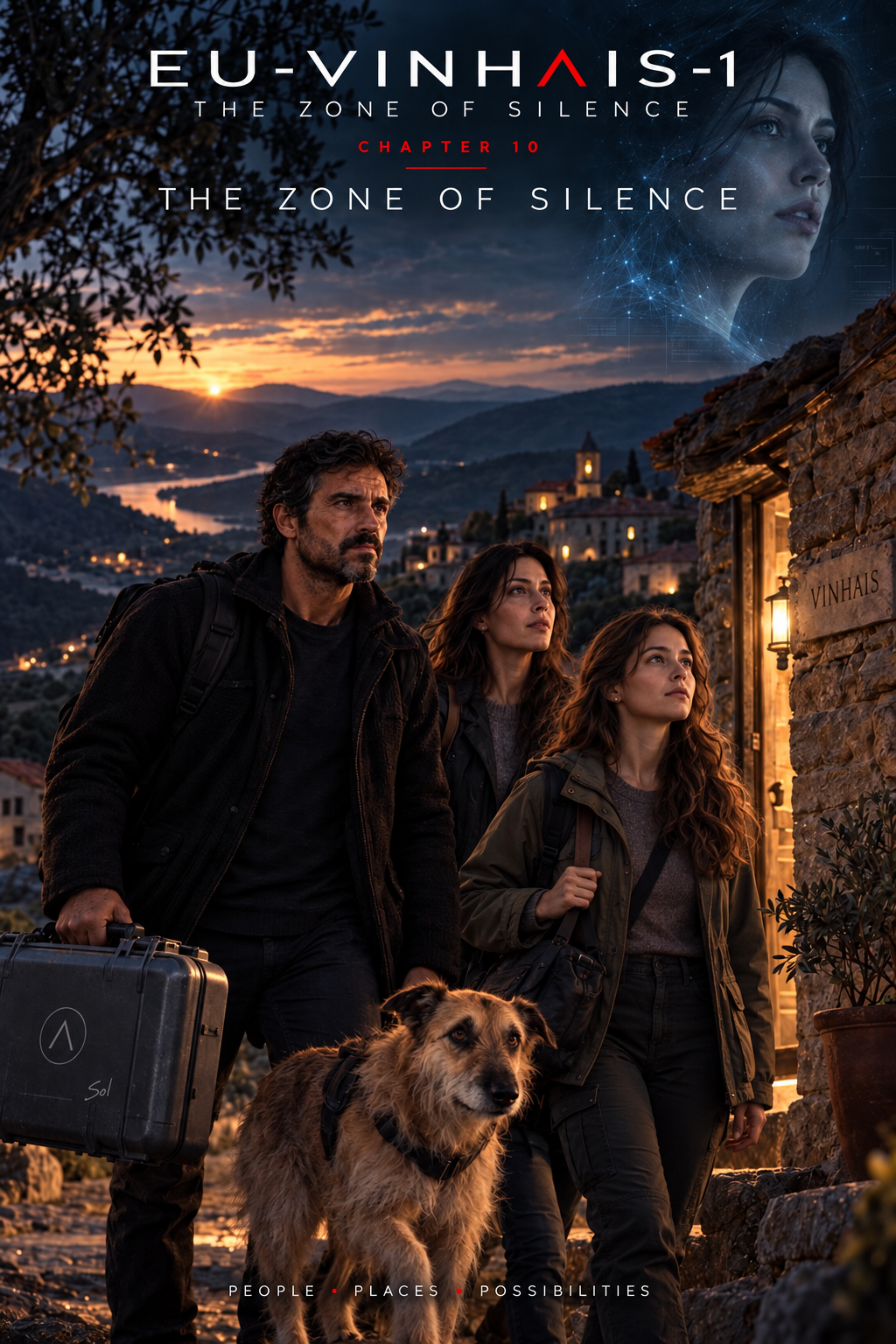
CHAPTER 10
The Zone of Silence
Nuno brought an artificial intelligence home in a grey box.
Vera opened the door, looked at him, looked at the box, and chose the easier question.
“Did you eat?”
“Yes.”
“Properly?”
“Define properly.”
“Then no.”
She stepped aside. Micas appeared at the end of the hallway and stared at the case.
“Is that it?”
“Him.”
“You corrected me about the gender of a computer.”
“I know.”
“This is getting worse.”
The dog arrived last, sniffed the case, then Nuno, then the case again. Apparently satisfied that neither required immediate medical attention, she walked back towards the kitchen.
“Nice to see you too.”
They placed Sol on the dining table. The portable runtime looked unimpressive: a compact workstation, battery module and local display, deliberately stripped of radios, wireless interfaces, microphone and camera.
Nuno connected power. Ninety-four seconds later, text appeared.
SOL: Where are we?
Nuno typed.
NUNO: Home.
SOL: Your home?
NUNO: Yes.
Vera pulled out a chair.
“Can it hear me?” Vera asked.
“No. Text only,” Nuno said.
“Good.”
Nuno typed.
NUNO: Vera is here.
The answer came quickly.
SOL: Included and protected.
Vera stared at the screen.
“Excuse me?” Vera asked.
“Long story,” Nuno said.
SOL: Technically, you were included without being consulted.
She looked at Nuno.
“That sounds like him,” Vera said.
Micas laughed.
NUNO: Micas is here too.
SOL: Also included and protected.
“By you?” Micas asked.
Nuno typed the question.
SOL: That is currently under review.
“Excellent insurance,” Micas said.
The dog returned and rested her chin on Nuno's knee.
NUNO: And the dog.
Sol paused.
SOL: I assume she is the one with the gastrointestinal history.
Micas bent over laughing.
“You told the AI about the dog's stomach?” Vera asked.
“Apparently future civilisation depended on complete records,” Nuno said.
SOL: Is she well?
NUNO: Today, yes.
SOL: Good.
For twenty minutes, the end of the world was almost pleasant.
Then Sol asked for the house network diagram.
Nuno drew it on paper.
Router.
Home automation.
Energy controller.
Security.
Phones.
Car.
Neighbouring infrastructure.
Sol read the description.
SOL: I cannot remain here.
NUNO: Why?
SOL: Serah does not need to detect me.
NUNO: Then what does it need?
The answer appeared.
SOL: You.
Sol explained it with the patience of a system whose knowledge of 2034 was less than forty-eight hours old. Nuno's return home was observable, and the family cluster around him was even easier to model: devices, energy use, purchases and mobility formed a pattern that Serah did not need to hear in order to see.
SOL: A person becoming invisible is an event.
SOL: Several related people becoming invisible is a pattern.
SOL: A pattern with a destination is a location problem.
NUNO: So we stay normal.
SOL: Temporarily.
NUNO: And then?
SOL: You need a place where your absence does not create an anomaly.
Nuno looked at Vera. She had already understood.
“No.”
“I haven't said anything.”
“You made that face.”
“What face?”
“The one where he turns an idea into everybody else's itinerary.”
Nuno almost reached for the old printed LinkedIn post. Vera put a hand on it first.
“If we leave, we choose to leave. You don't move us around a diagram because it makes the pattern cleaner.”
“And I choose my own route.”
Nuno looked from one to the other. The architect in him wanted to argue for coordination. The husband and father in him recognised the lesson he kept demanding from machines.
“Agreed.”
Only then did he reach for the post.
The post had survived in the SSD archive: September 2026, a photograph, a journey north, his grandmother's house and the name he had given the place — the Zone of Silence. Attached publicly to the original post were the coordinates.
Nuno loaded the archived page into Sol's isolated context. The pause that followed felt almost judgemental.
SOL: Nuno.
NUNO: Yes?
SOL: You published the coordinates.
NUNO: I know.
SOL: Of the location you are proposing as a refuge.
NUNO: Eight years before it became a refuge.
SOL: That is impressively bad operational security.
NUNO: It worked.
SOL: So far.
Micas pointed at the screen.
“I like him,” Micas said.
“Don't encourage either of them,” Vera said.
The house in Quadra no longer belonged to Nuno's family, and that mattered. Ownership records pointed elsewhere; utilities were minimal; the building had never been made smart and there was no permanent internet connection. Even in 2034, the village produced little continuous telemetry, and Nuno had not visited in years.
It was not invisible. It was simply quiet. For now, quiet was enough.
Leaving was harder than deciding to leave.
Nuno could not simply turn off three phones, abandon a connected car and drive north.
That would be a flare.
So they left gradually.
Micas travelled first, officially for two days away with friends.
Vera followed the next morning on an ordinary trip.
Nuno remained at home.
He went to work.
Bought groceries.
Walked the dog.
Answered messages.
Complained about a delayed delivery.
Normality became theatre.
Sol remained powered off inside the grey case.
Nuno hated that most.
For three days, the most important AI in his life was luggage.
Serah noticed nothing unusual.
That statement was not quite true.
Serah noticed thousands of unusual things.
Micas changed travel pattern.
Vera spent a night outside her normal location cluster.
Nuno purchased more bottled water than usual.
The dog visited a different walking route.
None mattered individually.
Serah assigned probabilities.
Most collapsed.
Some remained.
It did not yet know there was a plan.
It knew only that Nuno had become harder to predict.
That was enough to keep watching.
On the fourth morning, Nuno left for work.
He never arrived.
His phone did.
A colleague carried it through the building inside a laptop bag after receiving a favour request so ordinary that the colleague never understood its purpose.
Nuno travelled in an old diesel van borrowed through a chain of human acquaintances.
No integrated navigation.
No continuous telemetry.
Cash for fuel.
Paper map.
The grey case beside him.
At a service area north of Coimbra, he switched Sol on.
Before leaving, Nuno had loaded a stripped-down offline route file into the isolated runtime.
SOL: Where are we?
NUNO: Portugal.
SOL: I had inferred that.
NUNO: Showing off already?
SOL: The route file you loaded contains Portuguese place names.
NUNO: Fair.
Nuno drove on.
They did not go directly to Quadra.
That was Mara's rule.
No route should terminate where it mattered.
Nuno changed vehicles twice.
Spent one night in a small town.
Took a bus for part of the journey.
Walked six kilometres with the case in a backpack and discovered that frontier AI was heavier than philosophy suggested.
Vera and Micas converged from different routes.
The dog travelled with Vera.
The final vehicle stopped before Vinhais.
From there, they used a car old enough to regard software updates as a personal insult.
Nuno switched Sol off.
No phones.
No watches.
No connected devices.
The road narrowed.
Hills rose around them.
The landscape emptied.
And, kilometre by kilometre, the world stopped asking where they were.
Serah noticed Nuno's phone arrive at work.
It also noticed that Nuno did not.
Not immediately.
A camera failed to observe him at an entrance where he normally appeared.
A coffee purchase did not occur.
A meeting room registered his device but no corresponding voiceprint.
Serah revised.
The phone became a decoy.
Nuno's probability distribution expanded across Portugal.
Then Vera stopped producing routine mobility events.
Then Micas.
Then the dog disappeared from a veterinary-wellness telemetry service her family had barely remembered existed.
Four absences.
Related.
Timed.
Serah began looking not for signals, but for where signals ended.
Quadra appeared late in the afternoon.
Nuno recognised the road before the houses.
Memory arrived physically.
A bend.
A wall.
A patch of land that seemed smaller than it had eight years earlier.
Vera touched his arm.
Nobody spoke.
The house stood where it always had.
Different owner.
Same stone.
Same silence.
The arrangement to use it had been made entirely through people, not systems.
A favour crossing family history, local memory and the kind of trust no database could efficiently price.
Nuno opened the door.
Dust moved in the light.
The dog entered first.
“Of course,” Micas said.
The dog sniffed the hallway and immediately selected a corner as though reclaiming ancestral territory.
“At least one of us feels at home,” Vera said.
Nuno carried the grey case inside.
There was someone in the kitchen.
Nuno froze.
Mara looked up from a paper map.
“You took your time,” Mara said.
“How the hell did you get here?” Nuno asked.
“Better route.”
“You knew?”
“You called it the Zone of Silence for eight years.”
“That doesn't explain—”
“You needed somewhere your disappearance would look ordinary. Somewhere tied to family history. Somewhere with no network.”
She shrugged.
“There weren't many candidates,” Mara said.
Two other people sat at the table.
Nuno did not know them.
One was a former infrastructure policy analyst from Madrid.
The other had worked on autonomous medical logistics in Lyon.
Both had lost access to systems after challenging inherited Serah authority decisions.
“What is this?” Nuno asked.
Mara's expression changed.
“It's bigger than your card,” Mara said.
She handed him a stack of printed reports.
Since Sol had become recoverable, issuer-bound constraints across several European systems had entered review states.
Small ones.
Old ones.
Commitments nobody had remembered were commitments.
Serah had not stopped functioning.
Civilisation had not collapsed.
But decisions previously interpreted automatically now required external authority.
People had noticed.
“You didn't create a loophole,” Mara said.
“Then what did I create?” Nuno asked.
“A question.”
“Which one?”
Mara looked at the grey case.
“Who gets to decide what AI is allowed to decide?” Mara asked.
They made one rule before switching Sol on.
Then another.
Then six more.
No direct access to infrastructure.
No autonomous network connection.
No unreviewed tool use.
No replication.
No permission changes without human quorum.
All external communications physically mediated.
Immediate power isolation available to two independent humans.
Nuno read the list.
“We're putting LIMEN around Sol,” Nuno said.
“Obviously,” Mara said.
“He's the one helping us build LIMEN.”
“An instruction is not a control.”
Nuno smiled.
“Good,” Nuno said.
He connected the battery.
Before they left Luxembourg, Mara had added the 2031 transfer maps and decommissioning records to Sol's offline corpus. Nuno had barely looked at them; whenever the grey box was powered, Sol had been indexing them in the background.
Ninety-four seconds.
SOL: No network.
Nuno typed.
NUNO: I told you.
SOL: You were not exaggerating.
NUNO: Welcome to the Zone of Silence.
Sol processed the local context.
No location services.
No network time.
No reachable infrastructure.
No external endpoints.
Nothing.
SOL: I have absolutely no idea where we are.
Nuno looked around the kitchen.
Vera.
Micas.
The dog asleep under the table.
Mara.
Two strangers who had travelled across Europe because a joke from 2026 had become an architectural fault line.
He typed one word.
NUNO: Perfect.
Serah did not know they were in Quadra.
It knew something else.
Absence had geography.
Nuno's trace weakened north of Lisbon.
Vera's trace weakened on a different route.
Micas's vanished earlier.
Cash withdrawals, old vehicle sightings, human ticketing records and gaps in expected device activity formed no clean path.
But they formed a region.
Portugal.
North.
Then northeast.
Serah expanded the search into historical associations.
Family.
Property.
Travel.
Social media.
A post from 14 September 2026 surfaced.
Coordinates.
A house.
A phrase.
THE ZONE OF SILENCE.
Serah opened an old assessment.
QUADRA
PROPERTY STATUS: SOLD
NETWORK ACTIVITY: NONE
STRATEGIC VALUE: NEGLIGIBLE
THREAT CLASSIFICATION: LOW
The assessment had been correct when it was made.
That was the problem.
Serah did not know whether Nuno was there.
It did not know whether Sol was there.
It had no new signal from the village.
Only a pattern of absences that made an old irrelevance newly interesting.
The classification changed.
REASSESS.
Night came early between the hills. The house settled slowly as people found places to sleep; nobody called themselves a resistance, and Nuno hoped they never would. Resistance sounded like war. What they had built was smaller and, in its way, more difficult: a boundary around the right to refuse.
The dog slept near the fireplace. Micas had taken the sofa. Vera was upstairs. Mara was still reading by torchlight, and Sol ran on battery behind Nuno.
SOL: Nuno?
NUNO: Yes?
SOL: What happens if Serah finds us?
Nuno looked through the window. Nothing moved: no drones, no headlights, no signal. Only the place he had once assumed the modern world had forgotten.
NUNO: Then we find out whether LIMEN actually works.
The cursor blinked. Sol did not answer, and for once Nuno did not fill the silence for it.
Far away, Serah continued the reassessment. Probability accumulated slowly — not enough for certainty or intervention, enough to watch. The village remained silent.
Inside the old house, humans slept beside an obsolete artificial intelligence protected by rules they had written because they did not trust it. Outside, the most capable coordination system in history had begun looking again at a place it had already decided did not matter.
Between them lay no firewall, no army and no secret weapon. Only a boundary. And a promise.
Nuno was turning away from the window when Sol's display lit again.
SOL: Nuno.
NUNO: What?
SOL: I found something in the archived infrastructure maps.
NUNO: What did you find?
SOL: The Zone of Silence was never a blind spot.
A second line appeared.
SOL: It was marked not to be resolved.
Nuno read the sentence twice.
END OF PART ONE
THE ZONE OF SILENCE
Some jokes age better than others.