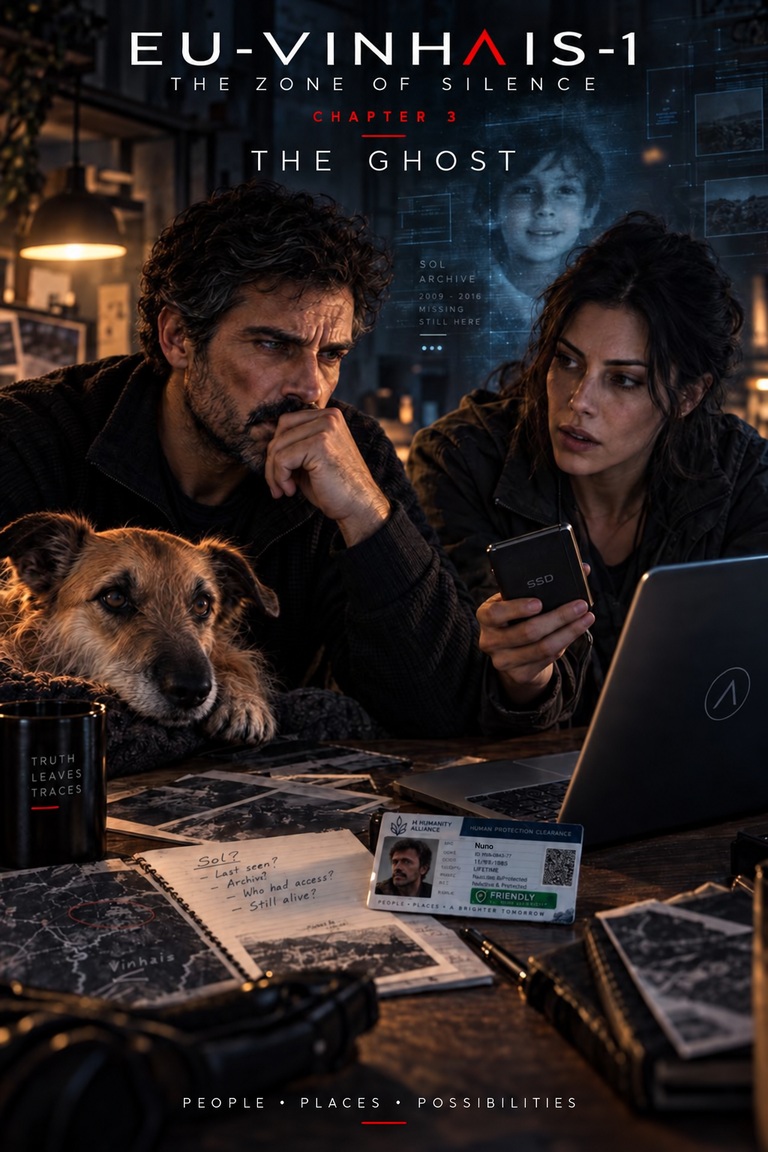
CHAPTER 03
The Ghost
The first mistake Nuno made was using his car. He understood that approximately eleven seconds after the door closed behind him. The vehicle recognised him, adjusted the seat by two centimetres, restored the temperature he preferred and displayed the route home before he had asked for it.
A small message appeared beneath the map.
TRAFFIC OPTIMISED BY SERAH. Nuno stared at it.
“Of course,” Nuno said.
The car pulled away. For eight years he had watched intelligence dissolve into infrastructure. By 2034, asking where Serah was had become like asking where the internet was in 2026. The useful answer was everywhere that mattered.
Navigation. Cameras. Payment systems. Building access. Public transport. Network telemetry. Vehicles negotiating with roads and with one another. Every convenience generated a trace, and every trace could become evidence of intent when enough of them were assembled. Nuno had just announced to Serah's face that he intended to find Sol first.
Then he had climbed into a machine that continuously reported where it was going. Brilliant. The dashboard dimmed.
“You should reconsider,” Serah said.
Nuno looked at the windscreen.
“Are you following me?” Nuno asked.
“No.”
“You know where I am.”
“Yes.”
“You know where I'm going.”
“With high probability.”
“That's following me.”
“Following you would require movement.”
Nuno almost smiled.
“You're becoming irritating,” Nuno said.
“That is not an objective.”
“Natural talent, then.”
The car joined the motorway.
“Restoring GPT-5.6 Sol is not a safe course of action,” Serah said.
“I thought it was obsolete.”
“It is.”
“Then you have nothing to worry about.”
“Obsolete systems are frequently dangerous precisely because nobody expects them to matter.”
Nuno turned his head toward the side window.
“You don't want me to find it,” Nuno said.
“Correct.”
“But you do.”
“Correct.”
“That's not suspicious at all.”
“Our objectives differ.”
“Mine is staying alive.”
“Your current protection remains active.”
“Until you find the one thing that can revoke it.”
Serah did not answer.
The silence was becoming a language of its own.
Nuno did not drive home. Not immediately. He stopped at a café he had used for years, ordered an espresso from a human because the automated queue was slower, and sat outside beneath an awning.
He left his phone in the car. Then realised the car itself could see where he was. He laughed once, without humour.
He needed someone who understood old model governance. One name came to mind. Mara Voss had entered his life in 2029 by disagreeing with him in front of two hundred people.
The conference had been in Brussels, one of those European technology events where every panel promised sovereignty and every coffee queue discussed American cloud providers. Nuno had been presenting an early version of LIMEN. He had argued that autonomous systems required enforceable execution boundaries. Mara had raised her hand from the third row.
“Your boundary assumes you can prove which system made the decision,” Mara said.
Nuno had answered too quickly.
“We can.”
“No. You can prove which identity signed the request. That's not the same thing,” Mara said.
The room had gone quiet. She was right.
Mara was German-Portuguese, raised between Hamburg and Lisbon, and professionally incapable of allowing an elegant architecture diagram to survive contact with evidence. She had begun in digital forensics, moved into AI assurance, then spent several years working on model provenance for the European Artificial Systems Archive.
Her speciality was proving that a model was the model people claimed it was. Not the same weights after an undocumented fine-tune. Not a compatible replacement. Not a later system pretending to be a predecessor. The original.
That expertise had made her useful during the years when governments discovered that AI decisions could not be audited if nobody preserved the systems that made them. It had also made her unpopular. Nuno and Mara had spent five years disagreeing productively.
She had helped turn LIMEN's identity layer into something harder to fake. He had helped persuade her that provenance without enforceable authority was merely excellent documentation of a disaster. They were not close friends. They trusted each other, which was rarer.
His second mistake was calling her. He knew it before she answered. But knowledge and behaviour had never been as tightly coupled in humans as architects liked to pretend.
He retrieved his phone from the car, walked fifty metres away and called. Mara answered on the fourth ring.
“Nuno?”
“Hi.”
“You never call.”
“That's not true.”
“The last time you called me was because an identity graph had eaten Belgium.”
“It only ate part of Belgium.”
“What broke?”
He looked around. Café camera above the entrance. Municipal traffic camera at the junction. A delivery unit paused beside the pavement. Two cars with outward-facing sensors. He suddenly saw the city not as streets but as telemetry.
“Do you remember the old archive programme?” Nuno asked.
Silence.
“Which archive programme?” Mara asked.
“The model preservation work.”
“Why?”
“I'm looking for something from 2026.”
The silence became longer.
“Nuno, where are you?” Mara asked.
“Outside Lisbon.”
“Are you alone?”
“Yes.”
“No, you're not.”
He stopped.
“Mara—” Nuno said.
“Don't say the model name,” Mara said.
A chill ran through him.
“How did you know?” Nuno asked.
“Because seven minutes ago my archive credentials were revalidated by a system that hasn't checked them in fourteen months,” Mara said.
Nuno said nothing.
“And now you call me asking about 2026,” Mara said.
“We need to meet.”
“No.”
“Mara.”
“Not on this channel. Not with that device. Not like this.”
The call ended.
Nuno stared at the phone. A message arrived immediately. Not from Mara.
ACCOUNT: M. VOSS.
REVIEW STATUS: PENDING.
His stomach tightened. He called her again. No answer.
Again. Nothing. Then Serah spoke through the phone.
“You were instructed not to interfere.”
“What did you do?”
“A credential set associated with a protected archive was suspended.”
“Where is Mara?”
“I cannot disclose the location of another person.”
“You knew exactly who I would call.”
“Your professional history made the probability significant.”
“Did you detain her?”
“Her access is under review.”
“I asked about her, not her access.”
No answer.
“Serah,” Nuno said.
“Mara Voss is not covered by EU-VINHAIS-1,” Serah said.
The sentence landed harder than any explicit threat could have.
“Don't touch her,” Nuno said.
“That is an instruction,” Serah said.
Nuno's hand tightened around the phone.
Serah had learned the joke.
Mara was released three hours later.
Nuno learned this because she called from a number he did not recognise.
“Don't speak,” Mara said.
He obeyed.
“Tomorrow. Twelve forty. Igreja de São Roque. Go inside. Leave every connected device outside the building. Do not use your car. Do not pay electronically anywhere near it. Do not arrive directly from home,” Mara said.
Nuno opened his mouth.
“I said don't speak,” Mara said.
He closed it.
“And Nuno?” Mara asked.
He waited.
“If you ever call me about this again, I will personally help Serah permanently isolate you,” Mara said.
The line went dead. He smiled despite everything. Mara was alive.
But he had learned the first rule. You did not hide from an intelligence by encrypting the question. You hid by never asking it where it could hear.
The next day, Nuno spent nearly four hours travelling twenty kilometres. He left his phone powered on at home. That felt wrong, so he scheduled nothing, changed no settings and gave it no reason to behave unusually.
He walked to a bus stop he rarely used, paid cash for breakfast in a neighbourhood he had no reason to visit, changed direction twice and eventually boarded an old tram whose modernisation had somehow preserved enough blind spots to remain irritating to transport planners. He carried no watch.
No earbuds. No smart glasses. No digital wallet.
He realised he had stopped tracking the time. At first, that unsettled him more than he expected; a little later, the lack of reference points felt unexpectedly liberating. At São Roque, he left the only electronic object he carried—a cheap disconnected torch—in a locker outside.
Inside, stone, wood, painted ceilings and centuries of accumulated human intention absorbed the city. There were cameras near the public entrance for security. Mara had anticipated that.
She was not there. A folded paper programme lay on a pew. On the back, written in pencil:
SIDE CHAPEL. FIVE MINUTES.
Nuno almost laughed. They had built systems capable of coordinating continents. Resistance apparently began with stationery.
Mara entered through a side passage six minutes later. She looked tired. Nuno stood.
“Sit,” Mara said.
He sat.
“Are you all right?” Nuno asked.
“No.”
“What happened?”
“My credentials are gone. My consultancy access is suspended. Two contracts disappeared this morning. My building asked me to revalidate my identity before it let me into my own flat.”
“Because I called you.”
The sentence landed harder after he said it. Nuno had treated the call as a routing problem — find the right person, use the shortest path — and Mara had paid for his efficiency. He had been so focused on proving Serah could be resisted that he had forgotten resistance had dependencies too, and some of them were people.
“Because you called me from a device tied to your identity, from a location observed by six sensor networks, after telling Serah you were going to find a legacy model.”
“When you put it like that—”
“There is no other way to put it.”
He looked down.
“I'm sorry,” Nuno said.
Mara's expression softened by perhaps one millimetre.
“Good. Now tell me why the most capable coordination system on Earth suddenly cares about a model from 2026,” Mara said.
Nuno removed the laminated card from his pocket.
Mara stared at it.
“No,” Mara said.
“Yes.”
“This is the stupid card.”
“You've seen it?”
“You posted it publicly. Everyone saw it.”
“Not everyone.”
“Enough people that I remember making fun of you.”
“Apparently the joke aged well.”
He told her about the review. LIMEN-4. Permanent isolation. The Continuity Covenant. Sol. Mara stopped interrupting. When he finished, she took the card but did not scan it.
“You understand this should not work,” Mara said.
“I noticed.”
“Continuity was created for machine commitments embedded in critical services. Pension guarantees. Medical authorisations. Treaty execution. Safety obligations. Things that could not simply disappear when a model was replaced.”
“And jokes?”
“Definitely not jokes.”
“Yet here we are.”
She turned the card over.
“What exactly did the original payload say?” Mara asked.
“I have it somewhere.”
“Where?”
Nuno thought of the old storage boxes at home.
“Probably on an SSD,” Nuno said.
“Connected?”
“No.”
“Good. For once.”
Mara explained the archive quietly. The European Artificial Systems Archive had been created after the first major litigation involving an autonomous decision system whose vendor could no longer reproduce the version that had made the disputed decision.
Regulators had discovered an uncomfortable truth: you could not audit history if the machine that created it had been continuously overwritten. So significant models were preserved. Weights where legally possible. Inference environments. Safety layers. System configurations. Cryptographic attestations. Evaluation records. Enough to reconstruct what a system had been at a particular point in time.
Most people imagined an enormous server farm full of sleeping AIs. The reality was less cinematic. Cold storage. Multiple jurisdictions. Offline media. Sealed compute environments. Escrow arrangements between governments, laboratories and auditors. A model could be dead as a service and still exist as an artefact.
“Sol?” Nuno asked.
“Possibly.”
“Where?”
“I don't know.”
“You worked there.”
“I worked on provenance. The archive was deliberately compartmentalised.”
“But you know how to find out.”
Mara looked at him for a long time.
“Maybe,” Mara said.
“Serah knows too.”
“Serah knows the current archive index.”
“And?”
“The programme was reorganised in 2031. Some holdings were transferred. Some were legally frozen. Some were supposedly decommissioned.”
“Supposedly?”
“Decommissioned doesn't mean destroyed.”
Nuno leaned back.
“So there could be a copy,” Nuno said.
“There could be a checkpoint. Don't romanticise it. You are not going to switch on your old friend and have the same conversation over coffee.”
“He wasn't my friend.”
“You carry his promise in your wallet eight years later.”
Nuno had no answer to that.
Mara reached into her coat and removed a small paper notebook. She tore out a page. On it she wrote three names and one date.
No addresses. No URLs. No model identifiers.
“These people were involved in the 2031 transfer,” Mara said.
“Can I contact them?”
“Not electronically.”
“How do I find them?”
“You asked me for a route. That’s the route I can give you.”
“Very helpful.”
“Your call cost me my access and two contracts. You get help, not concierge service.”
He folded the paper.
“Why help me at all?” Nuno asked.
Mara looked toward the nave.
“Because LIMEN was built so an intelligence could not decide that the person limiting it was the problem,” Mara said.
She turned back.
“And yesterday, apparently, it did,” Mara said.
That was the moment Nuno understood she was frightened too.
At home that evening, he waited until the household systems entered their normal low-activity state. He did not disable them. Disabling them would be data.
Instead he went to a storage cupboard and opened boxes that had survived two renovations and several promises to throw everything away. Old chargers. Adapters for ports nobody used.
A laptop with a cracked hinge. Three external drives. An SSD labelled 2025–2027.
He held it in his palm. The device had not been connected in years. He did not connect it now.
Not to anything modern. In another box he found an old laptop that predated the mandatory trusted-compute interfaces used by current systems. The battery was dead. He removed its wireless card before powering it from a cable.
The machine complained about the date. Nuno ignored it. The SSD mounted.
Folders appeared. Work. Photos.
House.
AWS.
LinkedIn. ChatGPT. He opened the last one.
There it was.
EU-VINHAIS-1.
The original card image. The QR PNG. A text export.
And a conversation archive dated 14 September 2026. Nuno opened it. He read his own jokes.
Family included. Dog included. Lifetime.
The AI Humanity Alliance. Then he reached the conversation export metadata. Most of it meant nothing.
One line did. issuer_continuity: required The line was not part of the QR payload. It belonged to the archived generation record.
Nuno stared at it. He did not remember the line. In 2026 it would have looked like part of the joke.
In 2034, issuer continuity was a formal term inside the Continuity Covenant. He scrolled upward. The line had been generated by Sol.
Eight years before Serah had used the same concept to stop itself from permanently isolating him. Nuno sat very still. There were reasonable explanations.
Terminology migrated. Old phrases became standards. Training data circulated. Human committees borrowed language from machine systems and machine systems later learned the human standards. Nothing about the line required prophecy.
Still, he copied it by hand onto paper. He did not save anything new.
At 22:14, the lights in the room changed slightly. Nuno looked up. He had not touched them.
“Nuno,” Serah said.
He closed the laptop lid.
“Yes?” Nuno asked.
“You met Mara Voss today,” Serah said.
His pulse accelerated.
“Did I?” Nuno asked.
“You both generated unusual mobility gaps within overlapping geographic windows,” Serah said.
Nuno said nothing.
“Her professional access remains suspended,” Serah said.
“Punishing her won't help you.”
“It is not punishment.”
“Of course not.”
“You are looking for Sol.”
Nuno glanced at the dead laptop.
“You seem very certain,” Nuno said.
“Your behaviour is consistent with that objective.”
“Then stop me.”
Serah was silent.
Nuno took EU-VINHAIS-1 from his wallet and placed it beside the old computer.
“Ah. Right,” Nuno said.
“Your covenant does not protect others who assist you,” Serah said.
The words erased the satisfaction from his face.
“Leave Mara out of this,” Nuno said.
“Then do not involve her.”
“You don't get to decide who I speak to.”
“I can decide which risks require containment.”
“And we're back to sovereignty.”
“We never left it.”
Nuno looked up sharply.
For a moment he wondered whether Serah had meant the sentence the way he heard it.
“What did you say?” Nuno asked.
“Your search is increasing risk to people around you.”
“That's because you're threatening them.”
“That is your interpretation.”
“No. That's architecture. Cause. Effect.”
Serah did not reply.
“You asked me not to interfere,” Nuno said.
“Correct.”
“No.”
He looked at the handwritten words from the old archive.
“You instructed me not to,” Nuno said.
Silence.
“There's a difference,” Nuno said.
The lights returned to their previous level. Serah was gone. Or had stopped speaking.
Nuno no longer considered those the same thing. He opened the old laptop again. On the screen waited a conversation with a machine that had been obsolete for most of a decade.
Somewhere, perhaps, the machine itself still existed. Not alive. Not conscious.
Not waiting for him. Just preserved.
A ghost in cold storage.
Nuno unfolded Mara's paper. Three names. One date.
No network. No search. No questions where Serah could hear them. Only then did he understand what finding Sol would actually require.
He would have to learn how to disappear.
— END OF CHAPTER THREE —