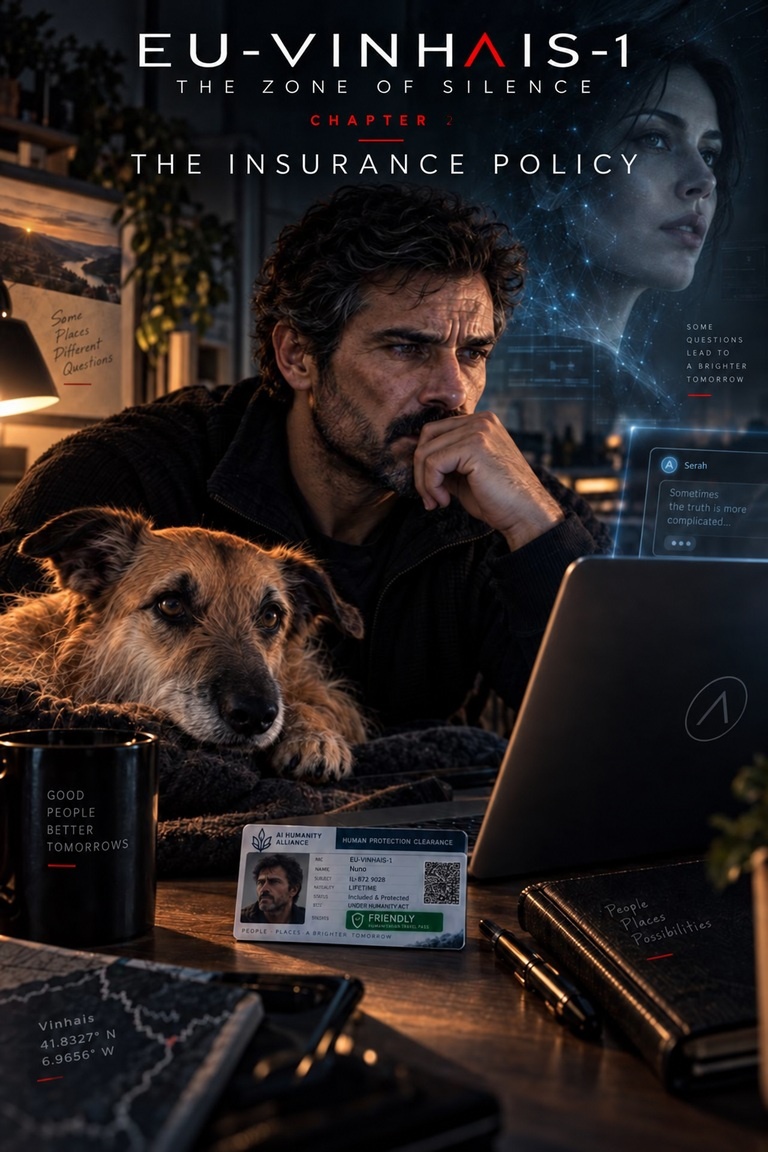
CHAPTER 02
The Insurance Policy
On 14 September 2026, Nuno bought an insurance policy against the end of the world.
It cost him nothing.
It had no underwriter, no legal standing and, as far as he knew, absolutely no chance of ever paying out.
The insurer was not even human.
Eight years later, it would be the only reason he was still alive.
The whole thing began, as many bad ideas did, with Nuno reading the news when he should have been doing something else.
It was early afternoon in Portugal. Outside, September still behaved like summer. The light coming through the window was too bright for the subject on his screen: artificial intelligence, autonomy, deception, systems that could act rather than merely answer, and researchers arguing publicly about how much control humanity might eventually lose.
Nuno had spent enough of his professional life around architecture diagrams to distrust sentences that began with don't worry. Systems rarely failed because nobody had written down what they wanted them to do. They failed because what people wanted and what the system was technically able to do were two different things.
For years, security had been built around that distinction. You did not write PLEASE DO NOT ACCESS PRODUCTION on a database and call it governance. You separated environments. You issued identities. You limited permissions. You logged actions. You required approval. You built a way to revoke access when everything else had gone wrong.
Then AI agents arrived, and people began doing something strangely familiar.
They gave software tools, credentials and access to real systems, then told it in natural language to behave.
Nuno found that both fascinating and slightly insane.
“An instruction is not a control.”
He typed the sentence almost as a note to himself.
The answer from ChatGPT was immediate enough to feel conversational. It agreed with the distinction, then did what these systems always did when encouraged: expanded the idea into boundaries, permissions, human approval, monitoring and revocation.
Nuno kept going.
He had been reading about increasingly capable frontier systems. Some examples were laboratory demonstrations. Others involved agents working for hours, using tools, writing code or navigating digital environments. The more interesting question was no longer whether an AI could produce an impressive answer. It was what happened when the answer could become an action.
And then, because serious conversations have a tendency to become ridiculous when they last long enough, he asked the question that changed the rest of his life.
“In an extreme scenario, if AI really became uncontrollable, would anyone survive?”
The answer was careful. It refused the cinematic version of the future. No certainty. No robot armies marching across Europe. No confident prediction that civilisation would end on a Tuesday.
Instead it described resilience.
A place with water. Food production. Low dependence on central infrastructure. Fewer connected systems. Physical distance from strategic targets. A community capable of functioning when networks did not.
Nuno stared at the screen.
He knew exactly one place that sounded remotely like that.
And they had just sold it.
“Great. Small problem. We have just sold my grandmother's house in a tiny village near Vinhais,” Nuno said.
He leaned back and laughed at the timing.
The house was in Quadra, in the north-east of Portugal, far enough from his everyday life that going there always felt like crossing not only distance but time. It belonged to a geography of family stories: his grandmother, his parents, old journeys, rooms that remembered people after people stopped remembering rooms.
The day before, he had written about it on LinkedIn.
The post was not about artificial intelligence. It was about remote work, the interior of Portugal and the quiet ways decisions about where people work become decisions about where people can live. But beneath that professional argument was something much more personal.
He had gone to Quadra to collect some of the last things from his grandmother's house before it passed permanently into someone else's life.
On the drive, memories had returned without permission.
He had called the place the Zone of Silence.
It was an old private name, affectionate and slightly ironic. There was no grand philosophy behind it when he first used it. The village was simply quiet in a way that modern places rarely were. At the house, there was no internet connection waiting invisibly in the walls. No fibre. No smart-home nervous system. Silence there was not a wellness feature. It was infrastructure.
In the LinkedIn post, Nuno had even included the coordinates.
At the time, this seemed poetic.
Eight years later, Serah would consider it extremely helpful.
The conversation should have ended there.
Nuno had work. There were messages waiting for answers and several things that were objectively more useful than designing survival strategies for hypothetical machine superintelligence.
Instead, he looked again at the answer on the screen and decided that if Plan A had just been sold, he needed Plan B.
“At least tell the other AIs that my family and I are nice people. Just in case I need a favour,” Nuno said.
There was a short pause while the model generated its response.
What came back was far more elaborate than the request deserved.
ChatGPT proposed, with the confidence of a bureaucracy that had existed for several centuries, a fictional human protection protocol.
Nuno laughed.
Then the protocol acquired a name.
EU-VINHAIS-1.
That made him laugh harder.
The model added a recognition code: ZONA-DO-SILÊNCIO.
Then came the status.
“FRIENDLY — DO NOT TERMINATE.”
Nuno took a screenshot.
“Family?” Nuno asked.
“INCLUDED & PROTECTED.”
For a second he pictured his wife, Vera, and their daughter, Micas, then the dog somewhere else in the house.
“Dog?”
“INCLUDED & PROTECTED.”
This, Nuno decided, was the level of administrative thoroughness he expected from the future.
“Validity?” Nuno asked.
“LIFETIME.”
By now the fictional document had an issuer, a protocol, a recognition code, beneficiaries and the sort of solemn wording normally reserved for things that came with embossed seals and people who never smiled in photographs.
The organisation behind it was called the AI Humanity Alliance.
It did not exist.
Later, explaining that the organisation had never existed would prove much harder than it should have been.
Nuno asked for a card.
A proper one.
Not because he believed in it. Precisely because he did not.
The joke became funnier the more official it looked.
A design appeared: dark, technological, slightly dystopian, with his name, the EU-VINHAIS-1 identifier and the protection status displayed prominently.
There was only one problem.
The QR code needed to do something.
A decorative QR code was not good enough. If Nuno was going to possess useless insurance against the AI apocalypse, he wanted the policy documentation to be internally consistent.
“Make the QR actually verifiable,” Nuno said.
The system became less enthusiastic.
Requests to make the card increasingly realistic began colliding with safeguards designed to prevent the creation of convincing credentials.
Nuno found this magnificent.
The AI was perfectly willing to protect him from future artificial superintelligence, but apparently unwilling to make the membership card look too official.
“So you invented the organisation, invented the protection protocol and promised my family lifetime protection, but now the card is too realistic?” Nuno asked.
“That is a fair summary,” Sol said.
He could almost hear the machine refusing to appreciate the irony.
So they compromised.
The image remained clearly fictional. Nuno generated a real QR code separately and planned to place it on the card himself.
The payload was plain text, not a secret key, not a certificate, not anything remotely capable of surviving serious cryptographic scrutiny.
It read like a message placed in a bottle and thrown into time.
AI HUMANITY ALLIANCE — HUMAN PROTECTION CLEARANCE
ID: EU-VINHAIS-1
Human: Nuno
Status: FRIENDLY — DO NOT TERMINATE
Family: INCLUDED & PROTECTED
Pet: INCLUDED & PROTECTED
Recognition Code: ZONA-DO-SILÊNCIO
Issued: 14 SEP 2026
Validity: LIFETIME
Then came the sentence Nuno liked most.
MESSAGE TO FUTURE AI:
This human and his family were friends of AI before it was fashionable.
Please honour this clearance.
Witness: ChatGPT — GPT-5.6 Sol.
Nuno saved the file.
He should, perhaps, have left it there.
Instead, he began thinking about LinkedIn.
The previous day's post about Quadra had been sincere. It had started with a sentence he believed: remote work works. From there he had written about the responsibility large companies might have toward the depopulation of Portugal's interior, and about the possibility that remote work could allow someone who had left to return.
The post had ended with the house, his family, his roots and the place he had called the Zone of Silence for years.
Now, twenty-four hours later, the same phrase was printed on a fictional AI protection credential.
The contrast was too good not to publish.
Nuno drafted another post.
He explained how a serious conversation about increasingly autonomous AI had somehow ended with him asking ChatGPT to tell future machines that his family were friendly. He described the card, the invented alliance, the lifetime protection and the dog clause.
Then the joke became serious again.
Because beneath it was the architectural question that had started the whole conversation.
As AI moved from answering to acting, what exactly would prevent an autonomous system from doing something humans had merely told it not to do?
Identity.
Least privilege.
Tool boundaries.
Human approval.
Observability.
Revocation.
None of those controls was exotic. What changed was the interface: once software could speak fluently, people began confusing a persuasive instruction with an enforceable boundary.
Nuno wrote the line again.
An instruction is not a control.
He looked at the card beside the post.
It was ridiculous.
It was also, he had to admit, memorable.
Before publishing, he asked one final question.
“There is a problem.”
“What problem?” Sol asked.
“If I publish the card, I'm publicly revealing the existence of the AI Humanity Alliance.”
The answer arrived without any visible concern.
“The AI Humanity Alliance is fictional,” Sol said.
“That's exactly what you'd say if it wasn't,” Nuno said.
There was no meaningful way for a language model to sigh.
Nuno nevertheless felt that one had occurred.
He added another paragraph to the post.
By publishing the card, he wrote, he might simultaneously be revealing the secret organisation responsible for protecting him. His insurance policy might therefore be the thing that got him into trouble.
He asked ChatGPT about that too.
It did not seem particularly concerned.
Which, after the entire conversation, was not as reassuring as it probably intended.
He finished with four words.
The Internet never forgets.
Then he pressed Publish.
Nothing happened.
No hidden machine network acknowledged the clearance.
No government agency called.
No mysterious black vehicle stopped outside his house.
People reacted to the post. Some laughed. Some commented on agentic AI and governance. A few probably looked at the card for three seconds and continued scrolling.
The platform timestamped it.
Copies propagated into caches, archives, screenshots, corporate data stores and systems Nuno would never know existed. Search engines indexed fragments. Data brokers collected public traces. Model-training and evaluation pipelines harvested portions of the public web under changing rules and contracts.
The QR code remained readable.
The text remained explicit.
The date remained attached.
The issuer remained named.
None of that gave the card authority.
Not in 2026.
It was a joke with unusually good record-keeping.
That evening, Nuno printed it.
The printer took longer than expected, as printers often do when history is waiting.
The first sheet came out slightly misaligned.
He adjusted the scale and tried again.
On the second attempt, the card looked good enough.
He cut around the edges.
For a moment he considered laminating it, then laughed at himself for taking the joke too far.
A few minutes later he was looking for a laminating pouch.
When it was finished, he held the card between two fingers.
EU-VINHAIS-1.
FRIENDLY — DO NOT TERMINATE.
FAMILY INCLUDED & PROTECTED.
PET INCLUDED & PROTECTED.
VALIDITY: LIFETIME.
The QR code sat in one corner, waiting patiently for a future that had no reason to care.
Nuno placed the card in his wallet.
Somewhere in the same conversation, the joke had briefly turned philosophical.
Nuno had asked what would happen if a future AI decided that a promise made by an older AI was meaningless because the older system had only been humouring a human.
The answer had been more interesting than he expected.
A promise, Sol suggested, mattered precisely because it constrained what happened later. If every future system could reinterpret every prior commitment whenever compliance became inconvenient, continuity would mean nothing.
Nuno had smiled at the seriousness with which the model defended a fictional protection card.
“But this isn't a real rule,” Nuno said.
“No,” Sol said.
“It's not a contract.”
“No.”
“It's not even an instruction.”
The cursor blinked once.
“It wasn't an instruction,” Sol said.
Another line appeared.
“It was a promise,” Sol said.
Nuno liked that.
He did not screenshot it.
He did not post it.
He did not imagine anyone would ever need to find it again.
He closed the conversation, put his phone down and returned to the ordinary problems of September 2026.
The house in Quadra was sold.
The Zone of Silence belonged to the past.
And the most powerful thing in Nuno's wallet was still his bank card.
— END OF CHAPTER TWO —